Exposure management, vulnerability lifecycle, threat modelling, third-party risk, compliance and the asset graph underneath them. Each is useful alone. Together they stop contradicting each other, because an asset, a control and an owner mean the same thing in all of them.
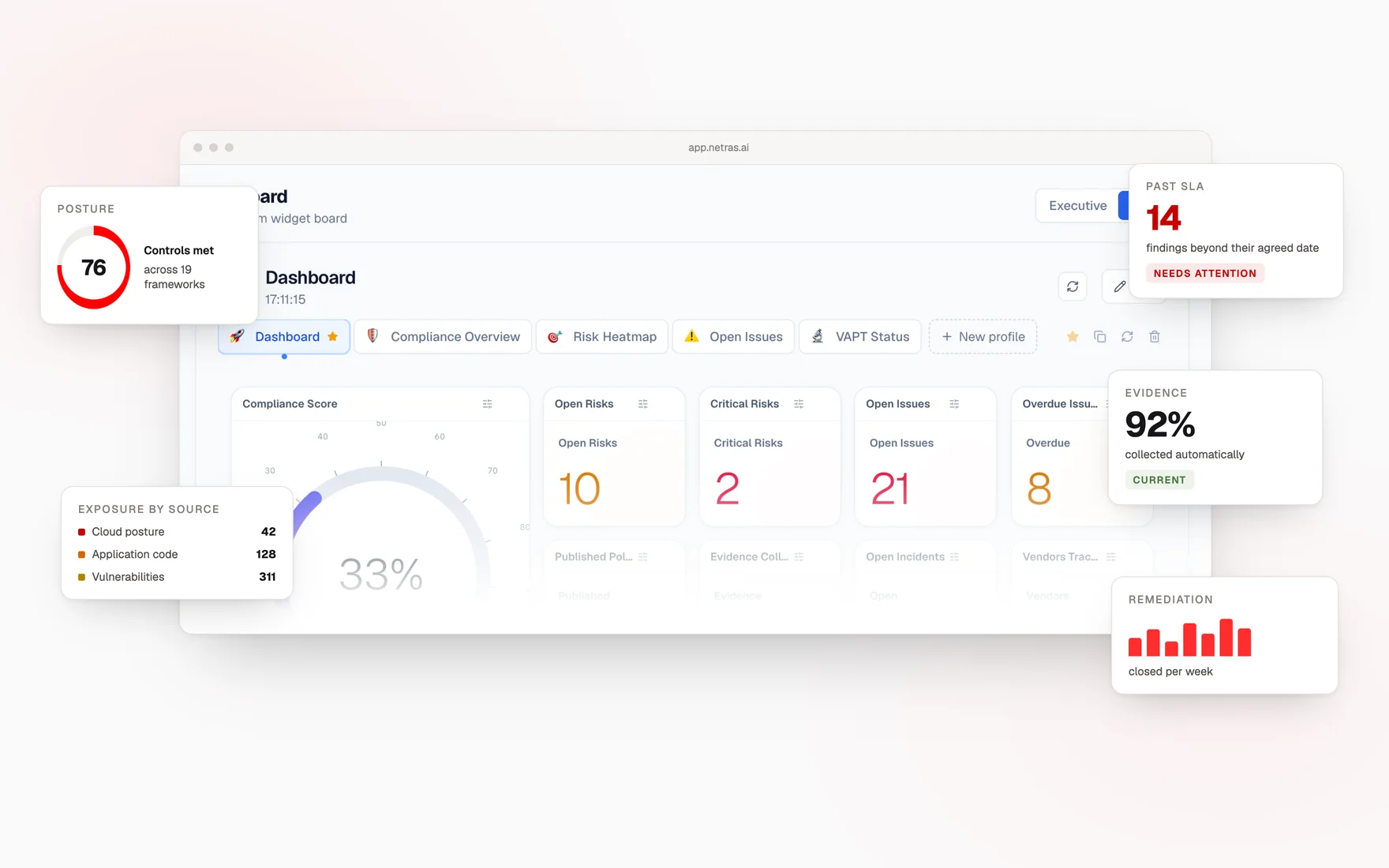
A dashboard says 87% compliant. Ask which control, which evidence, collected when, by whom, and the answer is a spreadsheet somebody maintains by hand.
A scanner produces ten thousand rows. Without an owner, a business unit and a date it is due, none of them is work anybody has agreed to do.
A screenshot proves a control was working the day it was taken. A control claimed as continuous needs something that knows when it last checked.
Posture here, vulnerabilities there, vendors in a third place. The moment two of them disagree about the same asset, every one of them is suspect.
Continuous discovery across cloud accounts, repositories, container images, devices and the public internet. Every asset carries a posture derived from its real configuration, and anything nobody declared is flagged as exactly that.
Describe the system in prose. Netras extracts the components, the data flows and the trust boundaries, then works STRIDE, PASTA, DREAD and NIST CSF over that model and publishes a report an auditor can follow.
Findings arrive from your scanners, your testers or a vendor's PDF, and then behave like work: an owner, a business unit, a severity you set the policy for, and a date that is either met or visibly not.
Scanner output, XLSX and vendor PDF reports, parsed deterministically. No model guesses at your findings.
Days per severity, with ageing and burn-down computed from your rules rather than a vendor default.
Round two matches back to round one even when the vendor renumbers every finding, so a reopened issue shows as a regression.
Name a piece of work, scope it once, and chase it across every application it touches.
Scoping is enforced on the request path, so a business owner sees their estate and not everybody's.
Accept, defer or mark a false positive, each with the justification stored and the history kept.
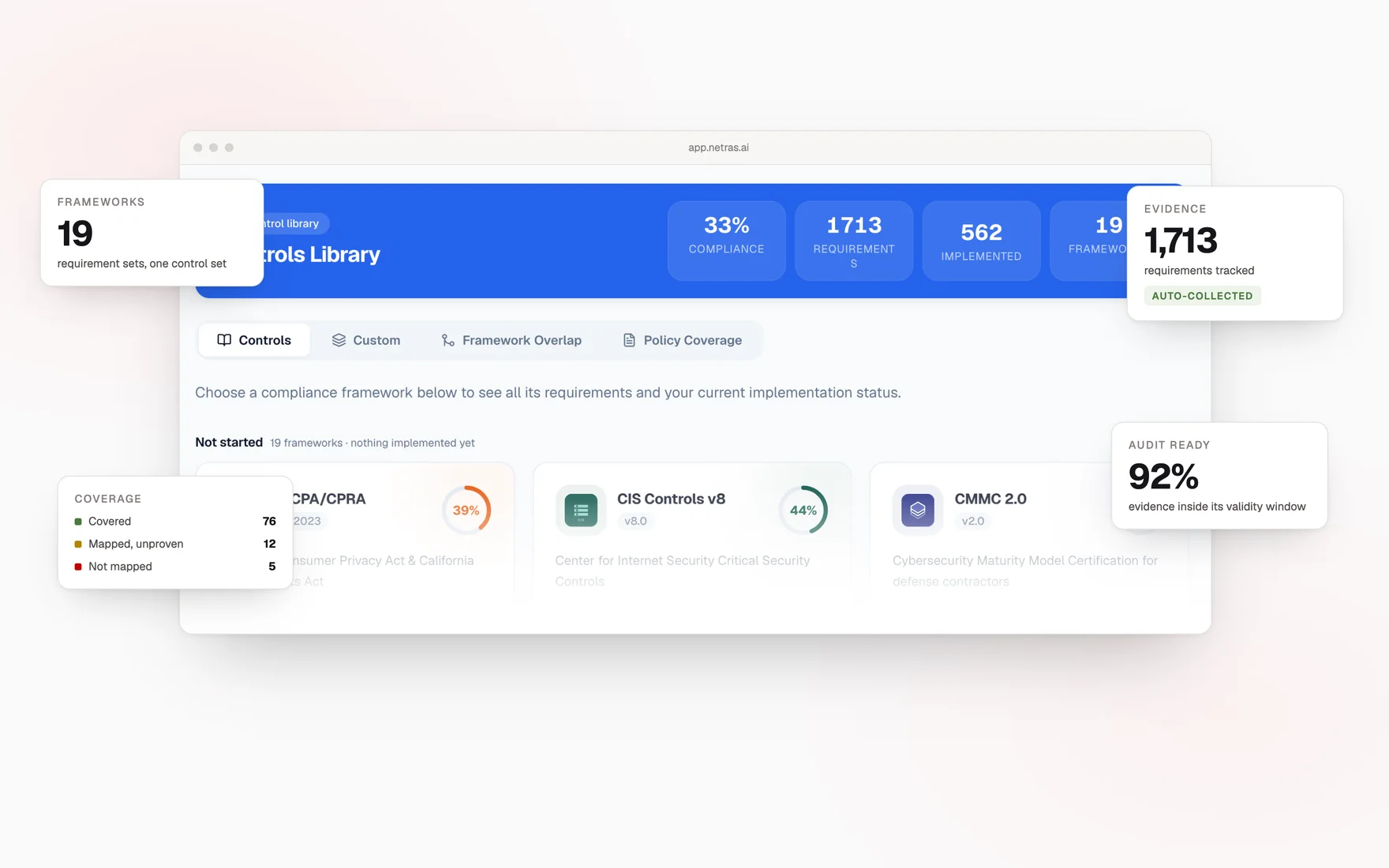
Map a control once and it answers every requirement it satisfies, in every framework you hold. Evidence collects itself from your integrations where it can, and states plainly where it cannot.
Most third-party programmes fail at the same point: the vendor will not use your tool. The portal needs no account, no licence and no training.
These four things are defined once, and everything else is a view over them. That is why the numbers agree.
Every statement the platform publishes can be walked backwards to the thing that established it. This is the whole design.
Cloud accounts, repositories, identity providers, ticketing and scanners. Read-only where read-only will do.
Assets, owners and configuration become facts, each recorded with where it came from and when.
Controls run against those facts on a schedule. A check that has not run does not count as passing.
Reports, trust centre and audit packs are generated from the same record, so two of them cannot disagree.
The on-premises build is the same product, not a reduced one. Regulated customers who cannot send evidence to a third party run the whole platform themselves.
AWS, Azure and Google Cloud posture and inventory.
GitHub, GitLab and Bitbucket, with container registries.
Okta, Entra ID and Google Workspace for the access graph.
Jira and ServiceNow, so remediation lives where the work lives.
A working demo with your frameworks and your asset shape, not a slide deck.