Free · no login

Netras.GRC: find your gaps before you spend anything

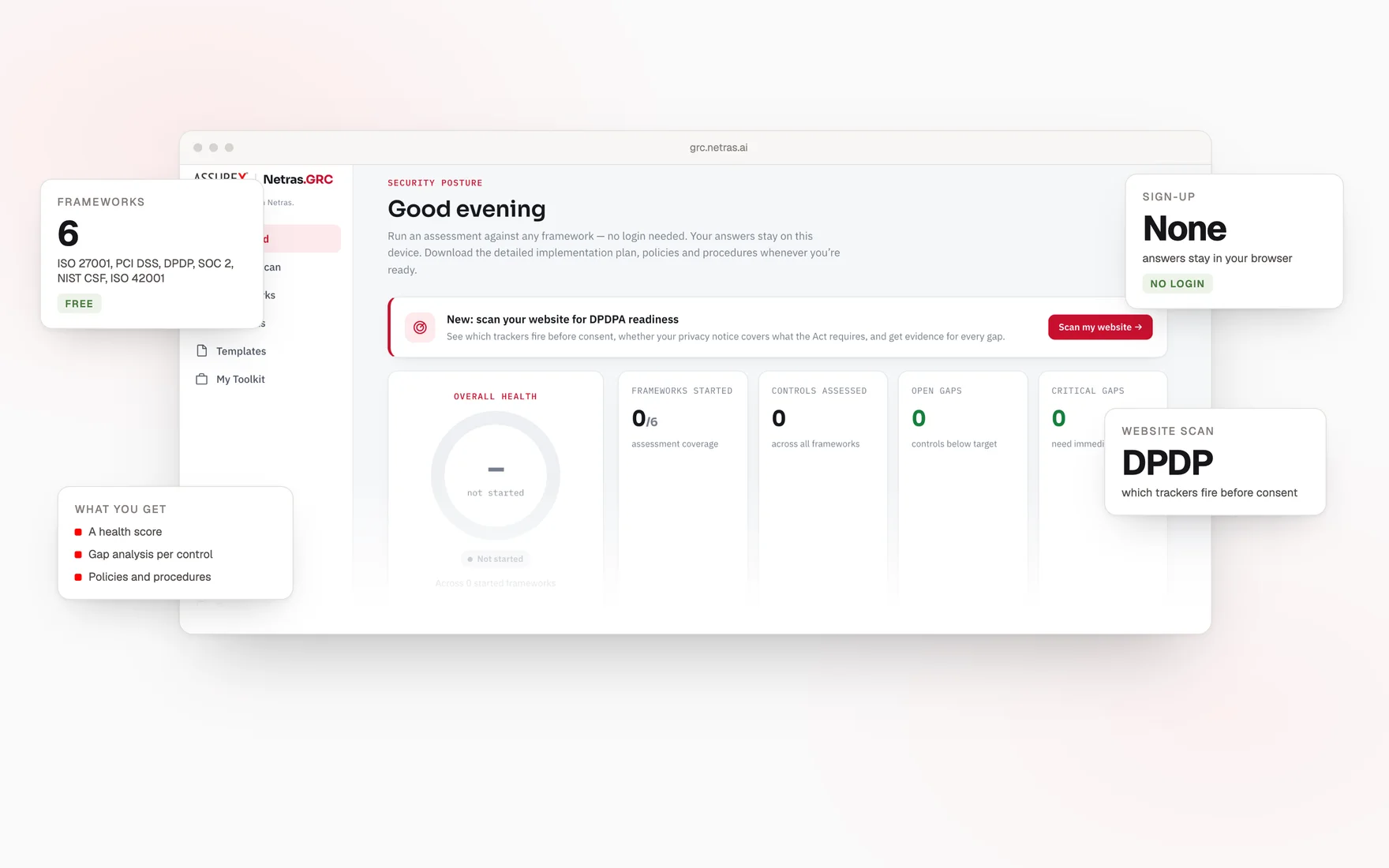
Run an assessment against any of six frameworks, get a health score and a gap analysis per control, and download the policies and procedures to close them. No account, no sales call, and your answers stay in your browser.
Start an assessment See the full platform
Six frameworksNo sign-upPolicy toolkit
Netras.GRC: six frameworks to assess against, a health score, gap analysis and a downloadable policy toolkit, with no login and answers held in your own browser
What it covers

Six frameworks, assessed control by control

Each one is the real requirement set, not a summary of it. You answer against the controls an assessor would actually ask about.

ISO/IEC 27001

ISO 27001:2022, built on the 93 Annex A controls. The international standard for an information security management system.

PCI DSS v4.0

Twelve requirements grouped into six control objectives, for any organisation that stores, processes or transmits cardholder data.

DPDP Act 2023

India's data protection law: consent-centric, with defined obligations for Data Fiduciaries towards Data Principals.

SOC 2

The trust services criteria, and the one most SaaS buyers ask for before they will sign.

NIST CSF

Identify, protect, detect, respond and recover: a maturity view rather than a pass or fail.

ISO/IEC 42001

The AI management system standard, for organisations that now have to answer for what their models do.

Also free

Scan your website for DPDP readiness

Point it at your site and it reports which trackers fire before consent, whether your privacy notice covers what the Act requires, and the evidence behind every gap it names.

  • Trackers that run before anyone has agreed to them
  • Privacy notice checked against what the Act actually requires
  • Evidence for each gap, so the finding is checkable rather than asserted
  • A 60-second health check if you want the short version first
Open Netras.GRC
What you keep

Checklists, templates and a toolkit

The assessment is the start. What makes it useful is the implementation plan, the policies and the procedures you can take away and put to work.

  • An implementation plan ordered by what to do first
  • Policies and procedures you can adapt rather than write
  • Checklists per framework for the evidence an assessor will ask for
  • Downloads need a verified work email, once per device, and nothing more
Where the line is

What the free tool is, and is not

Being straight about this is the point. A self-assessment is a good map and a poor certificate, and treating it as the second is how programmes go wrong.

What it is

  • A structured self-assessment against the real requirement set
  • A score and a gap list you can take to a budget conversation
  • Policies and procedures to close the gaps it finds
  • Private: answers stay in your browser, no tracking cookies, no analytics, no advertising

What it is not

  • Not an audit, and not legal advice: the results are indicative
  • Not evidence of a control working, because nothing is checked against your systems
  • Not continuous: it is a point in time, and so is its score
  • That is what the platform does, and why the two are different products
When you outgrow it

The same control set, proven rather than answered

The free tool asks you. The platform checks. Where an integration can read the configuration, the control re-runs on a schedule and the evidence carries the date it was established, so a claim stays true after the day you made it.

See the platform

Free assessment

You answer. Point in time. Your browser.

The platform

Integrations answer. Continuously. With provenance.

Six frameworks

The ones most people start with.

Nineteen frameworks

One control set across all of them.

Score yourself in the next ten minutes

No account, no sales call, nothing to install.

Start an assessment Talk to us instead