
Map a control once and it answers every requirement it satisfies, in every framework you hold. Evidence collects itself from your integrations where it can, and states plainly where it cannot. Coverage is counted honestly: unmapped and uncovered are not the same thing.
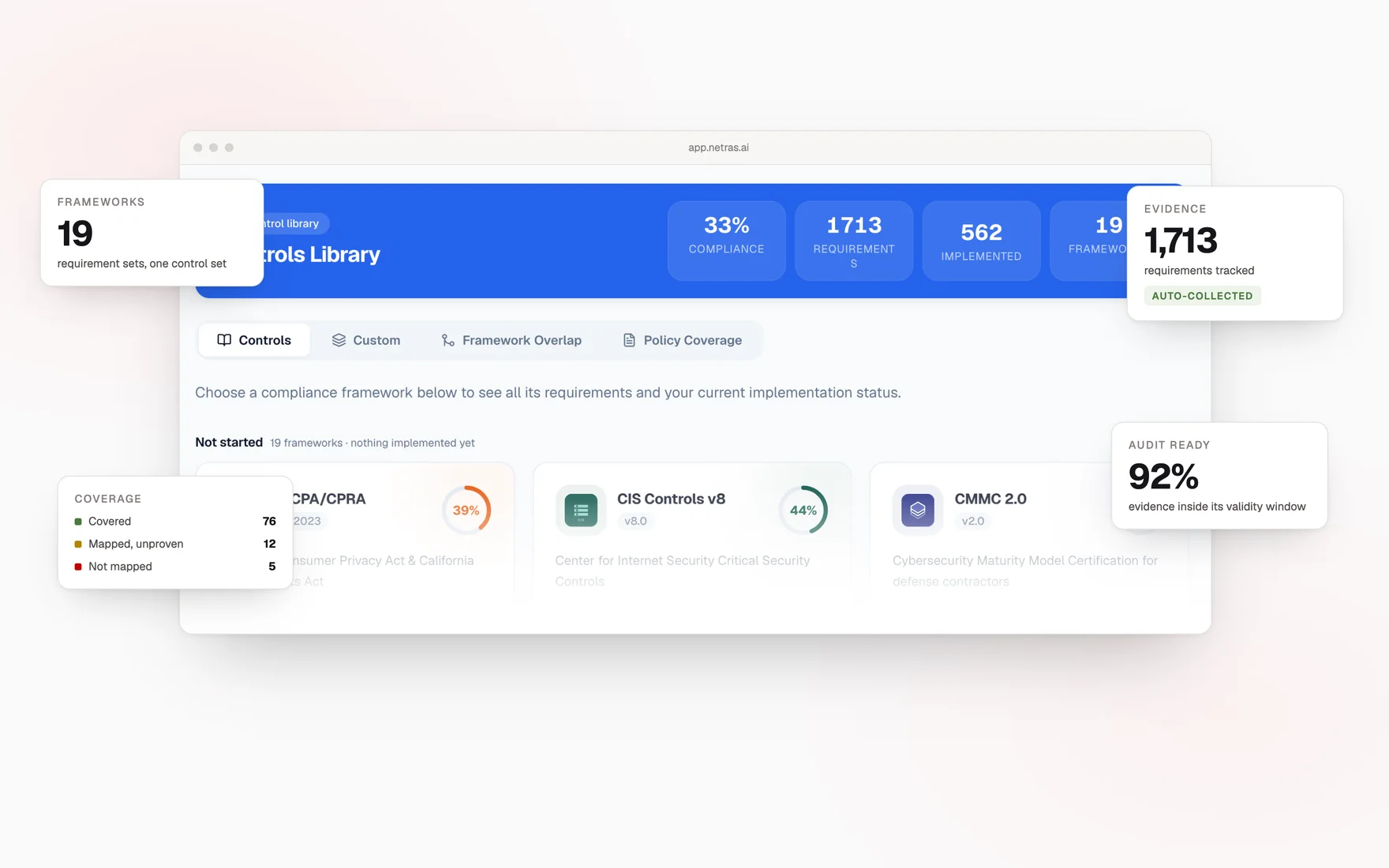
The reason multi-framework compliance is expensive is that most teams run it as several separate programmes. One control set, mapped to requirements, collapses the duplicated work.
Controls map to requirements, not to framework names. Coverage is then a real number, and a requirement nobody mapped is reported as unmapped rather than quietly as failing.
A control claimed as continuous runs on a schedule against your connected systems. A check that has not run is not counted as a pass, which is the whole point.
Each item records what produced it and when. Evidence collected by an integration cannot also be its own corroborating source, so a control never proves itself.
Policy authoring with acknowledgement tracking, security training, and access reviews, all hanging off the same controls rather than off a separate spreadsheet each.
Run your own audit cycles, and give an external auditor a scoped view that shows them what they need and nothing else.
Publish your posture to customers and prospects without handing over the evidence itself. The page is generated from the same record your auditor sees.
A requirement is covered when a control that satisfies it is in place and proven. Netras keeps the three states apart: covered, mapped but unproven, and not mapped at all. Collapsing those into one number is how a programme comes to believe it is further along than it is.
Nineteen authored requirement sets, including SOC 2, ISO 27001, PCI DSS, HIPAA, GDPR, NIST CSF, NIST 800-53, CIS and India's DPDP Act. Each is authored to the official public requirement count rather than to a summary.
Yes. Custom frameworks take your own requirements and map to the same control set, so an internal standard behaves exactly like a published one.
It depends on what you connect. Where an integration can read the configuration, the check runs on a schedule and the evidence carries its timestamp. Where it cannot, the platform says so rather than presenting a manual upload as continuous proof.
A working demo with your data shape, not a slide deck.